
 By
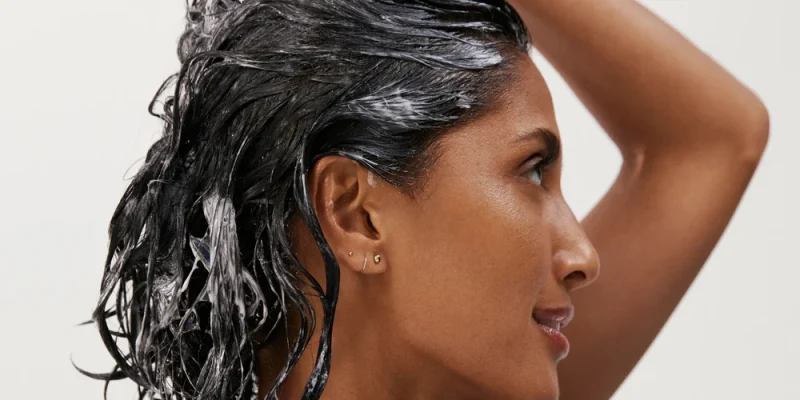
When your roots look oily but your ends feel dry, start by separating where you cleanse from where you condition. Shampoo belongs mainly on the scalp; conditioner belongs on the hair, with its placement depending on texture. Scrubbing the entire length as though every part needs the same treatment can make an ordinary washing problem harder to manage.
This distinction can get lost in the search for a perfect bottle. A person sees flattened roots, washes more vigorously, then dislikes how the ends feel. Another tries to protect dry lengths by postponing washing despite an oily scalp. Before buying another range, look at the route your hands and products take during the wash you already do.
Give the scalp the cleansing job
The American Academy of Dermatology’s healthy-hair guidance recommends applying shampoo to the scalp rather than working it through the entire length. The purpose is to remove accumulated oil, dead skin and products while avoiding unnecessary drying of the hair. That gives a clear answer to the apparent contradiction: an oily scalp and dry lengths can require different handling in the same shower.
Use the product according to its label, keeping attention on where you are applying it. If you habitually gather long hair on top of your head and scrub the whole bundle, notice how much of that motion concerns the ends rather than the scalp. More dramatic foam is not the objective. Cleansing the intended area is.
A useful way to think about the task is as two locations rather than two competing hair identities. You do not have to decide that your whole head is either oily or dry before you can wash it. The scalp is the starting point for shampoo application; the condition and texture of the length inform the conditioning step that follows.
This is ordinary care guidance, not a way to diagnose a scalp condition. It also does not replace directions for a prescribed or medicated product. If you have specific instructions from your clinician, follow those rather than adapting them to a general beauty routine. A washing technique cannot settle why a person is losing hair.
Put conditioner where your hair needs it
Conditioning is not simply repeating the shampoo motion with a different product. The same AAD guidance distinguishes fine or straight hair, where conditioner can be applied to the ends, from dry or curly hair, where it recommends conditioning the full length. The useful difference is the placement, not an assumption that everyone should copy the same amount or washing schedule.
For someone with fine, straight hair, that may mean consciously directing the conditioner towards the ends instead of automatically beginning at the roots. For someone with dry curls, concentrating only on the last few centimetres may leave most of the length outside the intended conditioning step. Read the directions and consider the hair you are actually handling.
Keep your aim concrete. You are trying to make the hair manageable through an appropriate routine, not prove that one texture category is healthier than another. Hair can also have different needs along its length after styling or processing. If you are uncertain about how those differences affect your routine, describe them plainly rather than collecting ever more labels.
Resist the temptation to answer a disappointing finish by adding several unfamiliar steps at once. If shampoo, conditioner, a mask and styling products all change together, it becomes difficult to describe what you liked or disliked. Keeping the application areas clear is a modest, understandable starting point. It does not require turning the bathroom into a product trial.
Let the next wash follow the scalp rather than a fixed challenge
A social-media instruction to wait a particular number of days can obscure what is happening on your own head. The AAD advises washing according to how dirty or oily the hair becomes, while accounting for hair type. It notes that a person with straight hair and an oily scalp may want to shampoo daily. A different texture can call for a different frequency.
That is a reason to stop treating the longest interval between washes as an achievement. If your scalp feels ready for cleansing, dry ends do not automatically mean the whole wash should be postponed. The placement distinction gives you another variable: cleanse the scalp thoughtfully and condition the appropriate parts of the hair.
Likewise, an extra wash does not need to become an extra round of vigorous rubbing. Keep the routine gentle. The AAD’s advice for people experiencing hair loss includes gentle shampoo and moisturising conditioner because fragile hair is easily damaged. That recommendation concerns handling; it should not be turned into a promise that a particular cosmetic routine will regrow hair.
Bring a specific handling problem to professional care
If you want help reviewing the routine, bring the actual mismatch: the scalp becomes oily while the lengths feel dry, and this is where each product goes. That is more informative than saying every shampoo has failed. It gives a hair professional something specific to discuss about application, texture and the finish you want.
For readers seeking that discussion in Mississauga, Truly You’s trichology service is a local hair-and-scalp assessment route. Keep the goal of that conversation clear. You may want help understanding your routine, while a medical diagnosis or unexplained hair loss requires the appropriate clinician. Those purposes can coexist without being treated as the same service.
Back at the sink, remember the useful physical distinction: shampoo starts with the scalp, and conditioner goes where your hair type needs it. Two areas can receive different attention within one uncomplicated wash. That small change in how you apply the products may be a more useful first observation than another promise printed on a bottle.




Comments